
When looking to refresh your facial appearance, erase fine lines, or restore youthful contours, cosmetic injectables offer one of the most effective non-surgical options available. However, navigating the choices can be confusing: Should you choose Botox or dermal fillers?
Although both treatments involve minor injections to combat signs of aging, they work through entirely different mechanisms. Choosing the wrong treatment can lead to underwhelming results—for instance, placing Botox in a fold caused by volume loss won’t lift the area, and placing filler into active muscle movement lines won’t relax the expression.
This guide breaks down how wrinkle relaxers and dermal fillers work, their treatment areas, average longevity, costs, and how combining them can provide comprehensive rejuvenation.
Understanding the Core Difference: Dynamic Wrinkles vs. Volume Loss
The simplest way to decide between Botox and dermal fillers comes down to what is causing the aesthetic concern: muscle movement or structural volume loss.
-
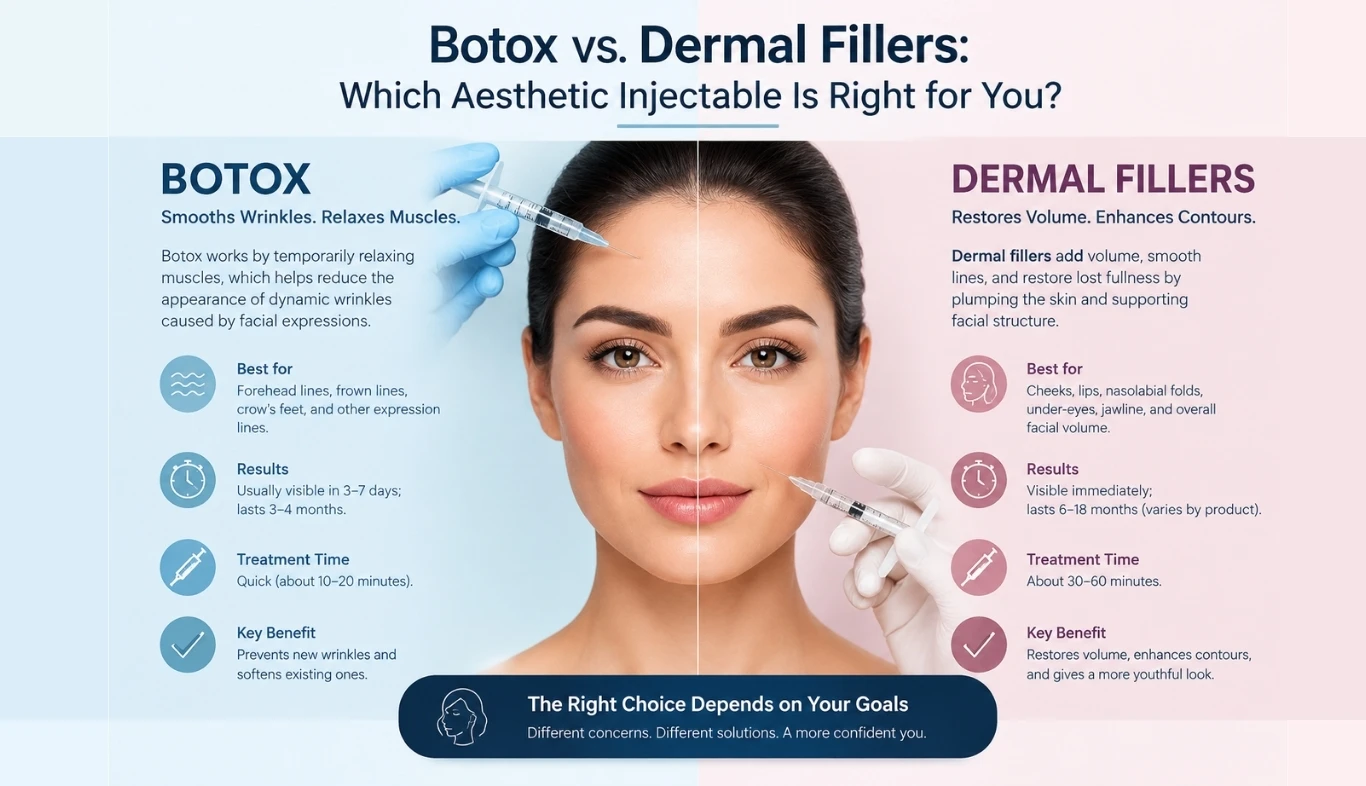
Botox (Neuromodulators): Relaxes the underlying facial muscles responsible for dynamic expression lines (wrinkles formed when smiling, squinting, or frowning).
-
Dermal Fillers: Restores volume, plumps deflated tissues, and fills static deep folds (lines visible even when your face is completely at rest).
| Feature | Wrinkle Relaxers (Botox) | Dermal Fillers (HA / Biostimulators) |
| Primary Function | Blocks nerve signals to temporarily relax overactive muscles | Restores lost facial volume, smooths deep creases, and contours facial structure |
| Target Lines | Dynamic lines (e.g., forehead lines, crow’s feet, frown lines) | Static lines & volume deficits (e.g., thin lips, hollow cheeks, deep smile lines) |
| Active Ingredient | Purified Botulinum Toxin Type A | Hyaluronic Acid (HA), Poly-L-Lactic Acid, or Calcium Hydroxylapatite |
| Time to Results | 3 to 7 days for onset; full results in 14 days | Immediate volume boost; final integration in 1 to 2 weeks |
| Average Longevity | 3 to 4 months | 6 to 18+ months (depending on product and treatment area) |
| Pricing Model | Charged per unit (US Avg: $10–$20 / unit) | Charged per syringe (US Avg: $650–$900+ / syringe) |
1. How Botox Works: Smoothing Dynamic Wrinkles
Every time you express emotion—whether frowning, smiling, or raising your eyebrows—the underlying facial muscles contract. Over time, these repeated movements cause the overlying skin to crease, creating dynamic wrinkles.
Mechanisms of Action
Botox (and other FDA-approved neuromodulators like Xeomin, Dysport, or Daxxify) works by temporarily blocking the acetylcholine signals from nerves to the targeted muscles. With reduced nerve signaling, the muscle relaxes, allowing the skin above it to smooth out naturally.
The Process: Repeated Muscle Movement → Forms Dynamic Wrinkle → Botox Blockade → Smoother Skin Surface
Ideal Treatment Areas for Botox
-
Forehead Lines: Horizontal creases created when raising the brows.
-
Glabellar Lines (“11s”): Vertical frown lines between the eyebrows.
-
Crow’s Feet: Fan-like fine lines around the outer corners of the eyes.
-
Bunny Lines: Fine diagonal wrinkles on the bridge of the nose.
-
Masseter (Jaw Contouring/TMJ): Slims a prominent jawline and reduces teeth grinding.
-
Lip Flip: A subtle flip of the upper lip border for enhanced lip show without added volume.
Candidate Profile & Longevity
-
Ideal Candidates: Adults looking to soften existing expression lines or prevent deeper static lines from forming early on.
-
How Long It Lasts: Typically 3 to 4 months. Regular maintenance treatments help train muscle habits, often prolonging results over time.
2. How Dermal Fillers Work: Restoring Structural Volume
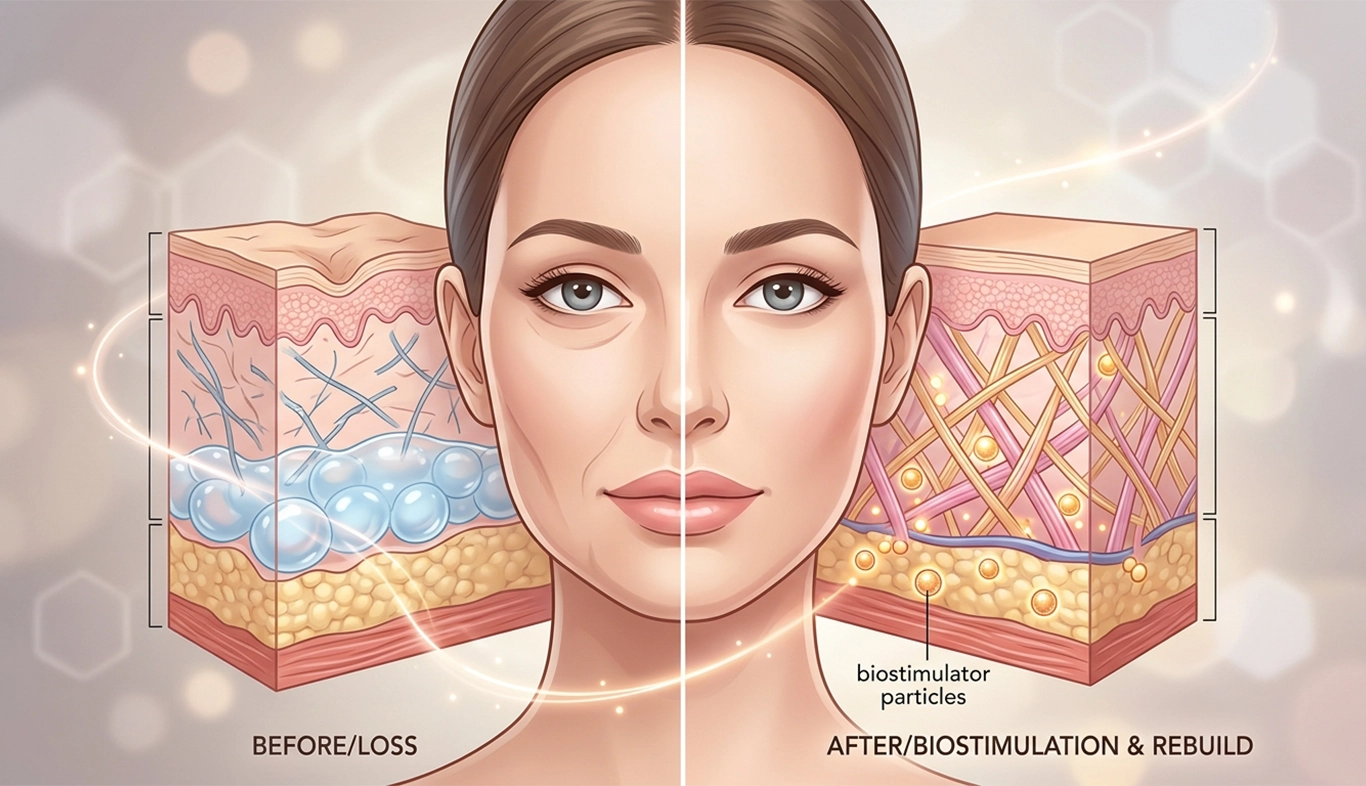
As we age, natural production of collagen, elastin, and hyaluronic acid slows down. Combined with bone reabsorption and the shift of subcutaneous fat pads, this causes facial sagging, thinning lips, and hollow contours.
Mechanisms of Action
Dermal fillers—most commonly formulated with gel-based Hyaluronic Acid (HA)—act like a supportive matrix beneath the skin. Hyaluronic acid is a naturally occurring sugar molecule that binds up to 1,000 times its weight in water, instantly providing volume, structural lift, and skin hydration.
Ideal Treatment Areas for Dermal Fillers
-
Lip Augmentation: Plumping thin lips, defining borders, and balancing asymmetry.
-
Cheek Elevation & Midface: Restoring loss of cheekbone prominence and lifting midface sagging.
-
Nasolabial Folds & Marionette Lines: Softening deep “smile lines” running from nose to mouth and chin.
-
Tear Troughs: Filling hollow under-eye areas to diminish dark circles and tired appearances.
-
Jawline & Chin Sculpting: Adding structure to a weak chin or defining a soft jawline.
Candidate Profile & Longevity
-
Ideal Candidates: Patients experiencing visible volume deflations, sunken features, deep static folds, or those desiring enhanced facial symmetry.
-
How Long It Lasts: Varies by product density and area movement, typically lasting 6 to 18 months (lip fillers average 6–12 months, whereas cheek/jawline structural fillers can last up to 2 years).
Cost Comparison: Per Unit vs. Per Syringe
Cost structures for injectables differ based on product type:
-
Botox Cost Structure: Priced per unit. In the US, prices range from $10 to $20 per unit depending on provider expertise and region.
-
Forehead Area: ~10–20 units ($150–$350)
-
Frown Lines (“11s”): ~15–25 units ($200–$400)
-
Crow’s Feet: ~12–24 units ($200–$400)
-
-
Dermal Filler Cost Structure: Priced per syringe. In the US, high-quality HA fillers range from $650 to $900+ per syringe.
-
Lip Enhancement: Usually 1 syringe
-
Cheek or Jawline Rejuvenation: 1 to 3+ syringes depending on structural needs
-
Combining Both: The “Liquid Facelift” Strategy
Many patients benefit most from using both treatments together. Because Botox relaxes dynamic muscles in the upper face and dermal fillers restore volume in the mid-to-lower face, combining them provides balanced, natural-looking facial rejuvenation without surgery.
-
Upper Facial Third: Targeted with Botox (Forehead, Brows, Crow’s Feet)
-
Mid & Lower Facial Thirds: Restored with Dermal Fillers (Cheeks, Tear Troughs, Lips, Jawline)
Choosing a Trusted Provider
Injectable treatments require an understanding of facial anatomy, muscle dynamics, and soft-tissue structure. To achieve balanced, natural results and avoid an overfilled or frozen look, treatments should be tailored to your unique features.
At SF Aesthetics Medspa, clinical care is led by experienced medical providers who focus on precise, safety-first technique. During a personalized consultation, your provider will evaluate your facial structure, discuss your aesthetic goals, and create a custom treatment plan—whether that involves targeted wrinkle relaxers, strategic dermal fillers, or a combination of both.